What'sNEW Apr - Jun 2026
 "Transposable elements as catalysts of evolutionary innovation," by Cedric Feschotte, doi:10.1038/s41576-026-00980-0, NRG [pdf], Jul 2026. "Transposable elements as catalysts of evolutionary innovation," by Cedric Feschotte, doi:10.1038/s41576-026-00980-0, NRG [pdf], Jul 2026.
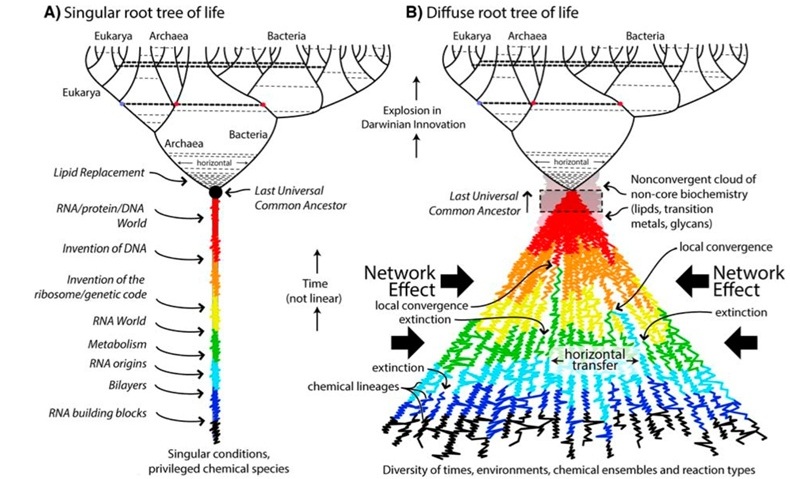
"Rethinking the Last Universal Common Ancestor of Life: Network Convergence and the Root of the Tree," by Loren Dean Williams et al, Astrobiology, doi:10.1177/15311074261452809 [pdf], accepted 05 May 2026.
 The RNA World and Other Origin-of-Life Theories has background and updates.
What Is Life? My answer is All life is cellular. Williams et al. elaborate All cellular life contains [a detailed list.]
The Tree of Life continues to accumulate horizontal connections.
01 Sep 2017: Team member Nigel Goldenfeld's earlier thoughts and conjectures about the origin-of-life. The RNA World and Other Origin-of-Life Theories has background and updates.
What Is Life? My answer is All life is cellular. Williams et al. elaborate All cellular life contains [a detailed list.]
The Tree of Life continues to accumulate horizontal connections.
01 Sep 2017: Team member Nigel Goldenfeld's earlier thoughts and conjectures about the origin-of-life.
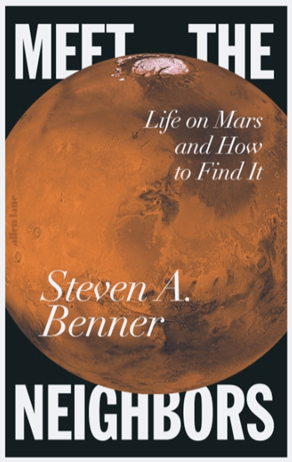
Consensus is deadly for science, says author Steve Benner, a biochemist of the highest rank. He believes the "preponderance of evidence" favored biology from the start; and that chemical results from subsequent landers, Opportunity, Spirit, Phoenix, Perseverance and Curiosity, virtually proved the case for life. The chemistry details sometimes get deep, but the reader will welcome Benner's plain language and familiar examples. And the reader will likely learn some things, as I did. For an informed, updated analysis of the Viking life-detection experiments, you can't do better. Another thing is even more baffling than NASA's reinterpretation of the life-detection experiments: If results are ambiguous, the obvious course of action is to follow up with experiments designed to remove the ambiguities. That hasn't happened. (What opportunities those rovers missed!) Benner mentions that Gil Levin, principal designer of the "Labelled Release" experiment, suggested a simple "Chiral" version that would certainly distinguish Earth-similar life from sterile chemistry, and do more besides. (If it's life, does it have Earth's chirality, or the mirror opposite? (Levin's collaborator, Richard Hoover, told me the proposal came back from NASA unopened.)) In fact there have been no experiments on Mars to detect extant life there since Viking. NASA has refused to even consider them. Why?! Benner concludes that cultural factors must explain NASA's blindness. His discussion ranges into the history of science, with interesting observations and speculations. But I came away still baffled. Why, for example, in 2004, would the Opportunity mission director, within only three hours, order the destruction of a tiny fossil that resembled remnants of a crinoid? What's the hurry? Why not stop and look, stop and think? Benner, an insider himself, doesn't mention this episode, but NASA's intransigence clearly troubles him. A talented and imaginative scientist, Benner has thoughts about the origin of life and the RNA World, even considering alternative biochemistries with five or six nucleotides instead of four. He discusses the definitions of life, ways to detect life-as-we-don't-know-it, and crowd-sourcing ideas for low-cost Mars experiments. He stresses the urgency for more robotic missions to seek life on Mars, before humans might forward-contaminate it. This is a very timely, edifying, enjoyable book. Good job, Steve!
"Gene ancestries reveal diverse microbial associations during eukaryogenesis," by M. Bernabeu, S. Manzano-Morales, M. Marcet-Houben et al, Nature, 10 Jun 2026.
Viruses and Other Gene Transfer Mechanisms has links to many examples of HGT in all kingdoms.
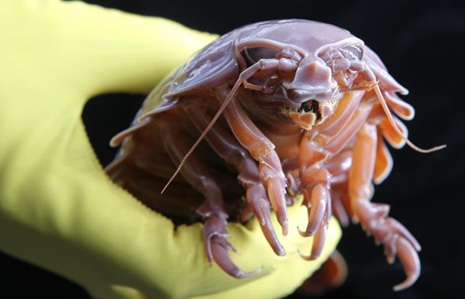 An animal snatches useful DNA directly from a completely different organism. ...This 'stolen' gene then underwent epigenetic optimization... with remarkable precision. These words come in commentary about an investigation of a mystery among supergiant isopods: How can they "survive more than five years without a single meal?" The study describes a textbook example of macroevolutionary progress enabled by cross-kingdom gene transfer, nstalled and optimized by operating software within the recipient genome.
"...Chinese scientists reveal how deep-sea supergiant organism survives five years without food," Xinhua +Phys.Org, 06 Jun +Reuters, 19 Jun 2026; re:
"Deep-sea megafauna co-opts microbial energy metabolism genes to withstand ultra-long starvation," by Jianbo Yuan et al, Cell [abstract], online 05 Jun 2026.
Viruses and Other Gene Transfer Mechanisms has links to many examples of HGT in all kingdoms.
Macroevolutionary Progress Redefined... has related discussion.
Robust Software Management is our name for a system to manage HGT and subsequent optimization.
An animal snatches useful DNA directly from a completely different organism. ...This 'stolen' gene then underwent epigenetic optimization... with remarkable precision. These words come in commentary about an investigation of a mystery among supergiant isopods: How can they "survive more than five years without a single meal?" The study describes a textbook example of macroevolutionary progress enabled by cross-kingdom gene transfer, nstalled and optimized by operating software within the recipient genome.
"...Chinese scientists reveal how deep-sea supergiant organism survives five years without food," Xinhua +Phys.Org, 06 Jun +Reuters, 19 Jun 2026; re:
"Deep-sea megafauna co-opts microbial energy metabolism genes to withstand ultra-long starvation," by Jianbo Yuan et al, Cell [abstract], online 05 Jun 2026.
Viruses and Other Gene Transfer Mechanisms has links to many examples of HGT in all kingdoms.
Macroevolutionary Progress Redefined... has related discussion.
Robust Software Management is our name for a system to manage HGT and subsequent optimization.
"Uncovering viral protein acquisition events and human-specific folds with pairwise comparisons of predicted protein structures," by Julia C Malnak, Saira Montermoso, Frederic D Bushman and Noam Auslander, doi:10.1093/molbev/msag110, Molecular Biology and Evolution, May 2026.
Viruses... has more about HGT.
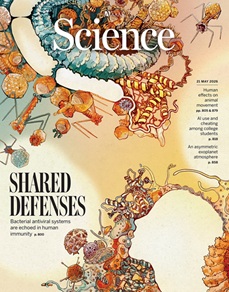 A lightning bolt ran through my mind... Immune proteins in human cells could be far more ancient than we'd thought. — Philip Kranzusch, University of California, Berkeley.
The cover story in a new issue of Science reviews new evidence for very old immune-system genes. Many of those genes in eukaryotes appear to have close relatives in bacteria and archaea. "You can imagine early eukaryotes coming along and plucking one from bacteria ...," says Aaron Whiteley of the University of Colorado Boulder. Very old genes acquired by cross-kingdom HGT are surprises for the mainstream theory of evolution; they are consistent with cosmic ancestry. Brothers in arms, by Richard Stone, Science, 21 May 2026.
Viruses... has more about HGT.
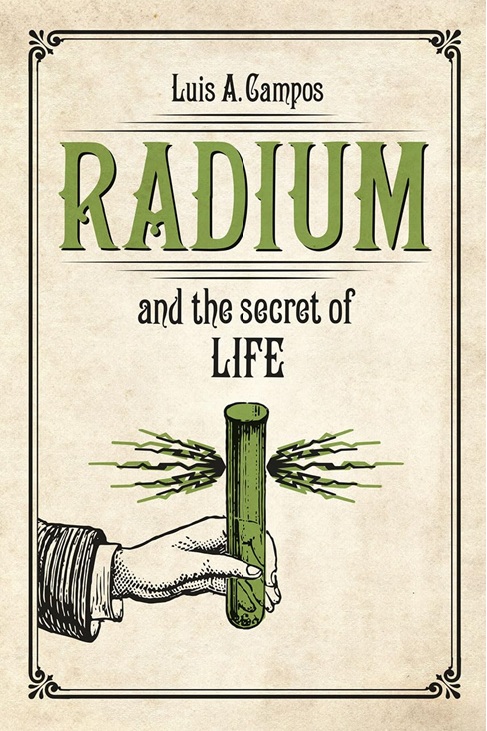 ...radium happened to radiate something that seemed to explode the scientific magazine, bringing thought, for the time, to a standstill — Henry Adams, 1907.
Dear Luis – It was a great pleasure to meet you at the Astrobiology Science Conference in Madison, Wisconsin, 17-21 May 2026. It was fun to see you and my wife laughing about college and discussing your shared admiration for Professor I.B. Cohen. I, too, am interested in the history of science, so I was glad to read your Radium and the Secret of Life. If radium can decay and eventually become another metal, lead, that discovery briefly threatened to revive the old fantasy of alchemy. I was fascinated. But even more interesting, radium seemed to offer a connection between physics and life, and maybe open a path to the origin of life. Your scholarship on that lengthy, complex episode is very impressive — the definitive account of it, I imagine. But let me confess: it reminded me of a more recent moment, when RNA was seen to have catalytic properties. That revelation has exploded into the RNA World, with equally complex narratives to explore, with equal excitement ...still under way. The entrance of quantum theory has had mixed consequences for biology. Yes, the recognition of discrete steps at the most basic level turns out to be a fruitful concept. But the insistence on randomness as the principal driver of mutations has persisted for too long. Luis, I would like to pique your interest in, not just the history of science, but also the philosophy of science, beginning with a principled, Humean skepticism. I think you could make a significant contribution. Please let me know if you have already delved into philosophy, in case I missed it. In any case, I recognize your deep research and excellent writing in Radium. Thank you. Best regards, Brig Radium and the Secret of Life, by Luis A. Campos, University of Chicago Press, 03 Apr 2015.
Did 3I/ATLAS Deliver Extrasolar Life to Our Backyard? by Avi Loeb, Medium, 25 May 2026.
Comets: The Delivery System has history and updates.
Genome instability triggers intercellular DNA transfer between human cells, by Elizabeth G. Maurais et al, Cell, 19 May; and Human Cells Found to Exchange Damaged DNA..., Trialsitenews, 20 May 2026; and Human Cells Can Pass DNA to Each Other Through Tiny Tubes..., Discover, 27 May 2026.
We know that bacteria can exchange genes via conjugation, but now we learn that mammalian cells have been observed to do this, a big surprise. And, the acquiring cell can apparently bequeath the acquired genes to its daughter cells. While this is very interesting, only somatic cells are implcated in this report. (Germ line cells would presumably have undamaged alleles of the same genes, already, anyway.)
Viruses... includes a brief discussion of bacterial conjugation.
Robust Software Management lists many software management systems in cellular genomes.
So the organics missed by the Viking GCMS experiment, fifty years ago, weren't actually missing. BTW, might the organic macromolecules have been made by ancient biology? Diverse organic molecules on Mars revealed by the first SAM TMAH experiment, by Amy J. Williams et al, Nature Communications, 21 Apr 2026.
 Thanks, James Powers.
Life on Mars! has related discussion, history and updates about the Viking experiments. Thanks, James Powers.
Life on Mars! has related discussion, history and updates about the Viking experiments.
Largest-ever survey of physicists puts Standard Model of cosmology under scrutiny, University of Waterloo via Phys.Org, 12 May 2026; re:
"Big Mysteries Survey: Physicists' Views on Cosmology, Black Holes, Quantum Mechanics, and Quantum Gravity," by Niayesh Afshordi et al, APS survey Arxiv paper.pdf, 11 May 2026.
Thanks, James Powers.
The End and the Big Bang has related discussion, history and recent updates.
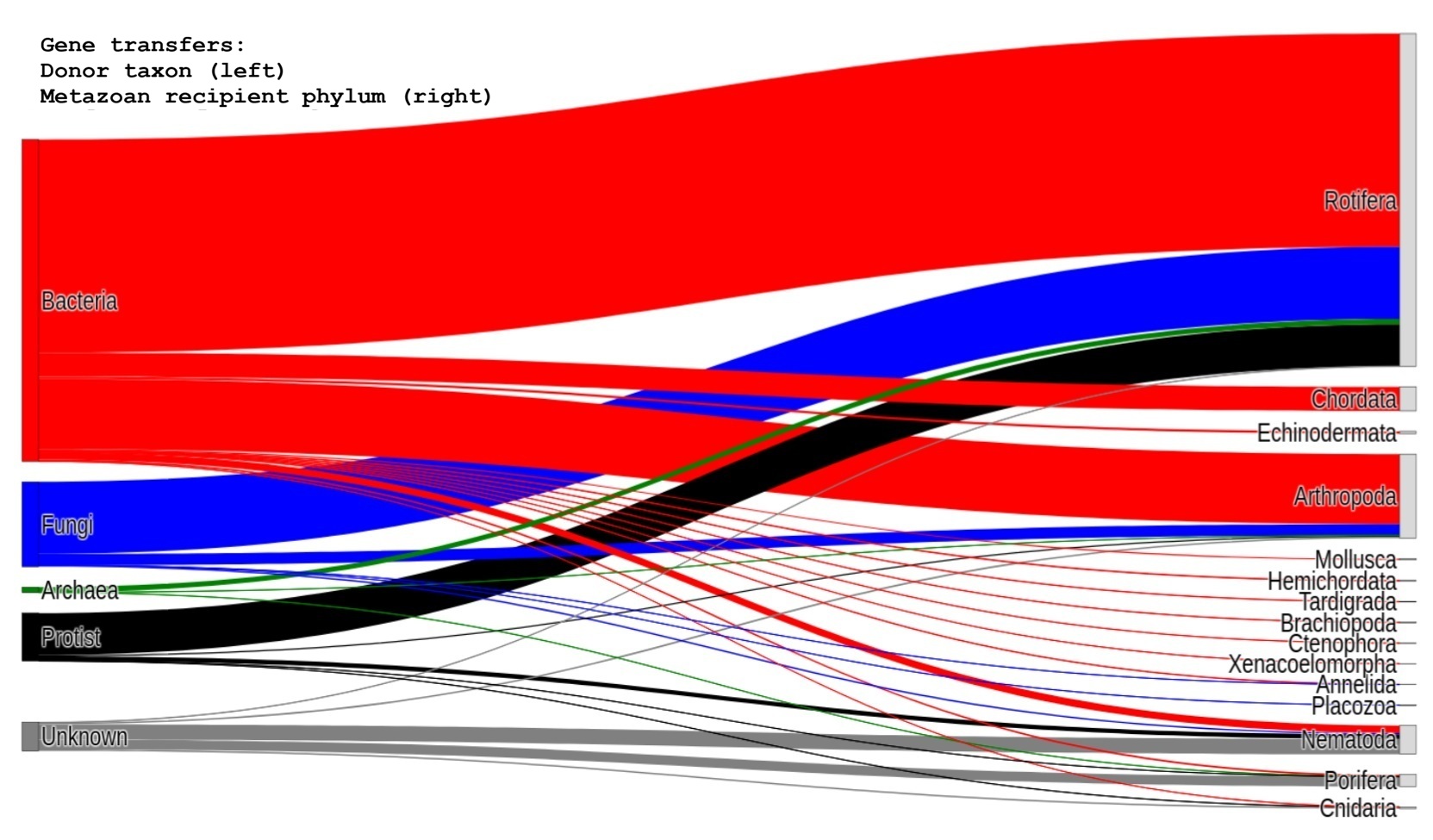
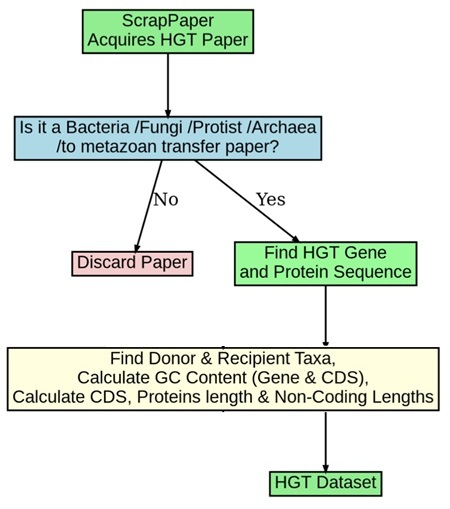 We compiled 9,495 protein coding genes that were identified as horizontally transferred ...from bacteria, fungi, archaea and protists to metazoans.
These words introduce a review of science articles, published between 2000 and 2025, whose titles contained the keywords "Lateral Gene Transfer," "Horizontal Gene Transfer" and "metazoan." The papers and candidate genes were further culled by additional criteria (illustration, right). Most of the transferred genes came from bacteria (red, below).
It was a meticulous, unusual, word-search-based project.
A compendium of horizontal gene transfers in Metazoa, by Johnathan A. Spaulding and Janna L. Fierst, Scientific Data, in press 04 May 2026.
Admittedly, the criteria were very restrictive. Most HGT genes go unrecognized anyway. Besides, protein coding genes occupy only a low fraction of metazoan genomes. And the percentage of metazoan genomes that have been sequenced is still small. To me, the study shows that the importance of inter-kingdom HGT for eukaryotic evolution is likely far greater than people recognize today.
Viruses: and Other Gene Transfer Mechanisms: lists thousands of examples.
The Tree of Life: has more about gene transfer.
We compiled 9,495 protein coding genes that were identified as horizontally transferred ...from bacteria, fungi, archaea and protists to metazoans.
These words introduce a review of science articles, published between 2000 and 2025, whose titles contained the keywords "Lateral Gene Transfer," "Horizontal Gene Transfer" and "metazoan." The papers and candidate genes were further culled by additional criteria (illustration, right). Most of the transferred genes came from bacteria (red, below).
It was a meticulous, unusual, word-search-based project.
A compendium of horizontal gene transfers in Metazoa, by Johnathan A. Spaulding and Janna L. Fierst, Scientific Data, in press 04 May 2026.
Admittedly, the criteria were very restrictive. Most HGT genes go unrecognized anyway. Besides, protein coding genes occupy only a low fraction of metazoan genomes. And the percentage of metazoan genomes that have been sequenced is still small. To me, the study shows that the importance of inter-kingdom HGT for eukaryotic evolution is likely far greater than people recognize today.
Viruses: and Other Gene Transfer Mechanisms: lists thousands of examples.
The Tree of Life: has more about gene transfer.
"Special Collection: An Origin of Life on Land," Astrobiology v26, n3-4, [ToC], and introductory article, "Revisiting Darwin's Warm Little Pond..." [link], by Bruce Damer and David Deamer, eds., Apr 2026.
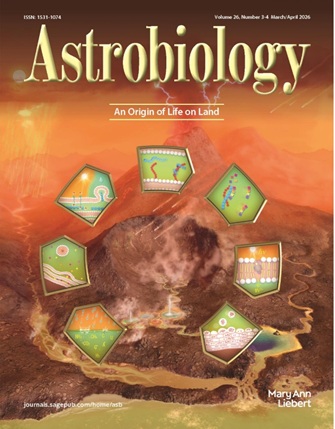 A Multilamellar Lipid Polymer Progenitor Can Promote the Assembly of Improbable Functional Polymer Complexes at Life's Origins, by Bruce Damer and David Deamer
Precellular System Models and the Struggle Against Reductionism: Revisiting a Scientific and Philosophical Debate, by José Alberto Campillo-Balderas et al.
From Space Dust to Protocells: Micrometeorites in Early Cellular Evolution, by Irep Gözen
Thanks, Bruce Damer, Antonio Lazcano and Irep Gözen, for sending copies of your articles before access restriction was lifted. Now I have posted those open-access links (above).
The RNA World: and Other Origin-of-Life Theories has history and updates. The "software problem" is still the elephant in the room. Damer and Deamer acknowledge it in their Introduction.
Genome pioneer Craig Venter dies..., by Ewen Callaway, Nature, 30 Apr 2026.
20 Jan 2005: Panspermia is how life is spread throughout the universe.
A Multilamellar Lipid Polymer Progenitor Can Promote the Assembly of Improbable Functional Polymer Complexes at Life's Origins, by Bruce Damer and David Deamer
Precellular System Models and the Struggle Against Reductionism: Revisiting a Scientific and Philosophical Debate, by José Alberto Campillo-Balderas et al.
From Space Dust to Protocells: Micrometeorites in Early Cellular Evolution, by Irep Gözen
Thanks, Bruce Damer, Antonio Lazcano and Irep Gözen, for sending copies of your articles before access restriction was lifted. Now I have posted those open-access links (above).
The RNA World: and Other Origin-of-Life Theories has history and updates. The "software problem" is still the elephant in the room. Damer and Deamer acknowledge it in their Introduction.
Genome pioneer Craig Venter dies..., by Ewen Callaway, Nature, 30 Apr 2026.
20 Jan 2005: Panspermia is how life is spread throughout the universe.
 Geobiology is "how Earth and life interact," says Andy Knoll, a founder of the field. His newest offering could serve as a textbook for the subject — there's that much information in it. But it is much more enjoyable than a textbook, because it includes lots of his personal reflections, experiences and interactions with colleagues. One early reader suggested it be published as a memoir.
Knoll begins by discussing the principal elements of life, and how they cycle through our world. Carbon is first, then Nitrogen and Phosphorus. Their "cycles" are complex, interwoven and worth knowing. To follow along, I occasionally got out Theodore Gray's The Elements. You don't have to. His analysis of Oxygen waits until Chapter 8, following his discussion of the origin-of-life. "Where did the first organisms come from?" he sensibly asks. Yet he does not mention panspermia, and the word is not listed in the index. Similarly, in noting that "amino acids have been detected in carbonaceous meteorites and even in interstellar space," he cites this as evidence that they can be made non-biologically. But there is a significant body of evidence suggesting that purported prebiotics in space are actually postbiotic. The ones in chondrites typically carry remnants of life's chirality. Knoll's usual rigor, investigative zeal and open-mindedness seem absent on this subject. Of course, I am presumptuous to criticize anything from a scientist of his stature. One of geobiology's advantages is its applicability to other planets and moons. Knoll is skeptical about life on Mars, okay. But I would love to hear his speculations about Titan, which he says is "perhaps the most interesting body in the solar system, save for Earth itself." It has an atmosphere about as thick as ours, dominated by Nitrogen, like ours, and it has abundant methane. I wonder if Titan's environment would make better sense if the story included life. If geology, mineralogy, Gaia, climate change, ocean chemistry, Mars exploration, plate tectonics, volcanoes, history of life, and history of Earth interest you, you could learn a lot from Andy Knoll, and enjoy doing it. I know I did. Earth and Life: A Four Billion Year Conversation, by Andrew H. Knoll, Princeton University Press, 2026.
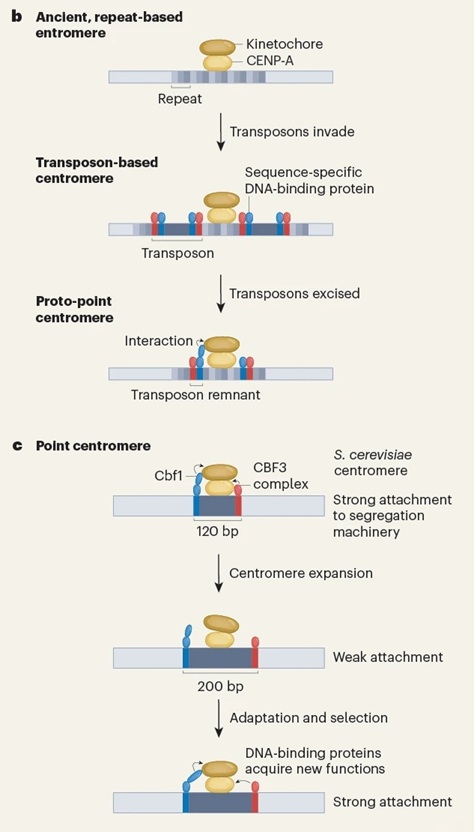
One way to investigate the opening question is to reconstruct the history of evolution with genomic sequences. The nucleotide sequence for a new genetic program should have predecessors. Can they be found? What story do they tell? This approach is rigorously pursued in open-access studies by two internatonal teams scrutinizing the rapid evolution of yeast "point" centromeres. A centromere is the segment of DNA that holds a pair of chromatids together and allows them to be pulled apart for reproduction. This function is unchanged in the course of the studies, so the evolved genetic programming is not overtly "new." Still, the observed genetic rearrangenments deserve attention. Adele Marston provides a helpful introduction to the subject:
One analysis is focussed on the rapid evolution of the point centromeres, while the complex kinetichore machinery that separates the chromatids changed very little. How did the two systems manage to remain compatible? Helsen et al. conclude that different variants of the centromere probably coexist until one is favored by selection.
Another team investigates the path from epigenetic and "proto-point" precursors to point centromeres in yeast. Their introduction concludes, "Comparative and phylogenetic analyses ...show how selfish elements can be co-opted to perform essential chromosomal functions."
The studies observe point mutations, optimization and "progressive" selection, so one might assume that ToE has been convincingly supported. It hasn't. Blocks of DNA have been inserted, deleted and rearranged, all following some logic that accidents don't explain. However, if existing genetic vocabulary is pieced together with genomic software analogous to software used by AI, the rearrangements can make sense. Testing Darwinism versus Cosmic Ancestry briefly describes three different tests.
Viruses... have a huge repository existing genetic vocabulary and a means for installation.
 Metal Beam on Mars? NASA photo scrutinized by Brian Cory Dobbs and Jean Ward, 8-min YouTube, 14 Aug 2024.
Life on Mars! has more about a wide range of evidence for more primitive life there. Metal Beam on Mars? NASA photo scrutinized by Brian Cory Dobbs and Jean Ward, 8-min YouTube, 14 Aug 2024.
Life on Mars! has more about a wide range of evidence for more primitive life there.
 ...thoroughly conscious ignorance... is the prelude to every real advance in science.
James Clerk Maxwell (1831-1879) was as influential as Newton or Einstein, according to The Man who Changed Everything, his biography by Basil Mahon. I first read it for its history of physics. Now I have reread it for its history of science. Polarized light was one of Maxwell's early interests. He employed it to reveal the stresses within transparent models of complex structures (a system still useful today.) His paper about it was poorly written, and he accepted that criticism. Ultimately he developed a style that is "authoritative, but fresh and informal." Occasionally he made algebraic mistakes! He made important contributions to color theory and statistical mechanics, but it was his discovery of the laws of electrodynamics that earned him a place in the pantheon of science — his four simple equations unifying elecricity and magnetism are revered like a sacred text. He had wrestled with the puzzle for years, trying various models, willing to start over if necessary. All the while, he admitted that the true nature of space is unknown, and the apparent dual nature of light would not be easily understood. Throughout his life, Maxwell was fallible, affable and undogmatic, as this biography makes clear. A pleasure to read, it is also instructive, and occasionally evocative. Illustrations include photos of Glenair, Maxwell's longtime Scottish home, in its heyday and, by 1991, in ruins. I recommend this book to everyone. The Man who Changed Everything: The Life of James Clerk Maxwell, by Basil Mahon, John Wiley & Sons, Ltd., UK, 2003.
(226 total pages, 25 pages of endnotes, a bibligraphy of ~50 entries, and an index of >700 names and terms.)
| |||||||||||||||||||||
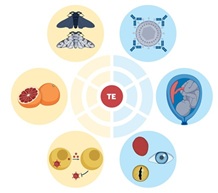 Transposable elements are acquired by transfer. For instance, among human TEs, "Approximately half were inserted in the primate lineage, and about 1% are unique to humans." After installation they may proliferate and become mobile, causing harm or conferring benefits. While research is ongoing, we already know some striking benefits emabled by TEs. These include industrial melanism in moths, frost protection in oranges and interferon response to viral infection, enabled by their regulatory activity. Proteins supplied by TEs have been essential for advances in adaptive immunity, placental development and even animal eyes, for example. As investigation continues, Feschotte believes that the recognition of TEs' importance for macroevolutionary progress "is destined to grow through every branch of the tree of life."