What'sNEW January–March 2008
 29 March 2008 29 March 2008
An amino-acid-like molecule has been seen in a dust cloud 25,000 lightyears away. A team at the Max Planck Institute for Radio Astronomy in Bonn used radio telescopes in Spain, France, and Australia to collect spectra from The Large Molecule Heimat, as the cloud is known. Among 3,700 separate spectral lines, 51 were attributable to amino acetonitrile, which closely resembles glycine.
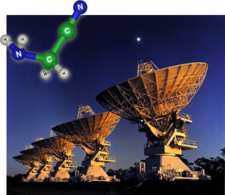
Since about 1965, more than a hundred different organic molecules have been detected in space. Orignally surprising, they are now welcomed as "prebiotic" ingredients for the origin-of-life. Thus, pseudo-panspermia has become mainstream. But instead, organic molecules in space could be "post-biotic" remnants of life, as stronger versions of panspermia would predict. We think this possibility should not be ignored.
 Arnaud Belloche et al., "Detection of amino acetonitrile in Sgr B2(N)" [abstract | PDF with spplements], doi:10.1051/0004-6361:20079203, p 179-196 v 482, Astronomy and Astrophysics, 2008. Arnaud Belloche et al., "Detection of amino acetonitrile in Sgr B2(N)" [abstract | PDF with spplements], doi:10.1051/0004-6361:20079203, p 179-196 v 482, Astronomy and Astrophysics, 2008.
 New organic molecule in space, Max-Planck-Institut für Radioastronomie, Bonn, 26 Mar 2008. New organic molecule in space, Max-Planck-Institut für Radioastronomie, Bonn, 26 Mar 2008.
Organics in the Mist, by Phil Berardelli, ScienceNOW Daily News, 28 Mar 2008.
 Panspermia Asks New Questions includes definitions of pseudo- and stronger versions of panspermia. Panspermia Asks New Questions includes definitions of pseudo- and stronger versions of panspermia.
Hoyle and Wickramasinghe's Analysis of Interstellar Dust is a related CA webpage.
 Thanks, Stan Franklin. Thanks, Stan Franklin.
27 March 2008
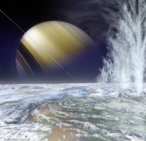 Could microbial life exist inside Enceladus...? The answer appears to be, yes, it could be possible. — Chris McKay and Dennis Matson
A Perspective on Life on Enceladus: A World of Possibilities, NASA, 26 Mar 2008.
Enceladus Hints at the 'L' Word, by Phil Berardelli, ScienceNOW Daily News, 26 Mar 2008.
Tasting a geyser, doi:10.1038/452516b, p 516 v 452, Nature, online 2 Apr 2008.
Seeds of Life Found Near Saturn, by Dave Mosher, Space.com, 26 Mar 2008.
Close Up of Enceladus' Tiger Stripes, Astronomy Picture of the Day, 31 Mar 2008.
Superficially unrelated articles in Nature... is about Enceladus, What'sNEW 30 May 2007.
Life on Europa or Other Moons? is a related CA webpage.
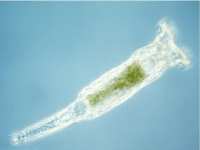
A bdelloid rotifer, c. 400 microns |
25 March 2008
Bdelloid rotifers have unusual properties. They reproduce only asexually, they remain viable after dessication at any life stage, and all of the transposable elements in their genomes transfer readily. Now, two biologists at Harvard and the Marine Biological Laboratory, Woods Hole, observe that they are are also "extraordinarily resistant" to ionizing radiation. Bdelloid rotifers are worm-like animals barely visible without a microscope. Numbering about 360 species, they thrive in a broad range of mostly freshwater habitats. For what it's worth, we think they might be able to remain viable in space.
Eugene Gladyshev and Matthew Meselson, "Extreme resistance of bdelloid rotifers to ionizing radiation" [abstract], doi:10.1073/pnas.0800966105, p 5139-5144 v 105, Proc. Natl. Acad. Sci. USA, 1 Apr (online 24 Mar) 2008.
Eugene A. Gladyshev et al., "Massive Horizontal Gene Transfer in Bdelloid Rotifers" [abstract], doi:10.1126/science.1156407, p 1210-1213 v 320, Science, 30 May 2008.
Tardigrades in space? is about another unusual animal, What'sNEW, 11 Mar 2002.
 How life might travel through space? points to a video about rotifers, What'sNEW, 9 Apr 2010. How life might travel through space? points to a video about rotifers, What'sNEW, 9 Apr 2010.
22 March 2008
Methane and water, but no carbon monoxide, can be seen in the atmosphere of an extrasolar planet 63 lightyears away. The analysis is possible because, from our vantage point, the planet eclipses its central star (HD 189773). Briefly then, every 2.2 days, astronomers can see starlight that is partially absorbed and scattered by the planet's atmosphere. The spectrum of that light, compared to the spectrum of the star's uneclipsed light, can reveal a lot about the atmosphere of the planet.
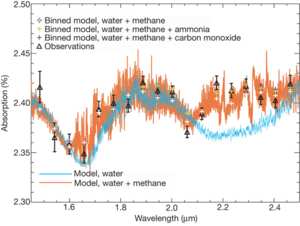 The lack of carbon monoxide rules out the favored nonbiological explanation for the existence of methane. Other explanations, such as "an ill-understood photochemical mechanism," are being proposed. The surface of the planet, a "hot Jupiter," is too hot for life as we know it. But could there be subsurface niches that are cooler? Could the methane be a "fossil" from an earlier time? On Earth anyway, methane comes from life.
Mark R. Swain et al., "The presence of methane in the atmosphere of an extrasolar planet" [abstract], doi:10.1038/nature06823, p 329-331 – and commentary by Adam P. Showman, "Extrasolar planets: A whiff of methane," doi:10.1038/452296a, p 296-297 v 432, Nature, 20 Mar 2008.
Hubble Finds First Organic Molecule on an Exoplanet, Hubblesite.org [also Newswise.com], 18 Mar 2008.
Whiffs From an Alien World, by Phil Berardelli, ScienceNow Daily News, 19 Mar 2008.
Where is HD 189733?, Astronomy Picture of the Day, 21 Mar 2008.
Hubble camera spots traces of life-forming gas, Los Angeles Times, 20 Mar 2008.
Stuff of Life (but Not Life Itself) Is Detected on a Distant Planet, by Dennis Overbye, The New York Times, 20 Mar 2008.
Hoyle and Wickramasinghe's Analysis of Interstellar Dust is a related CA webpage.
Life on Europa or Other Moons? is a related CA webpage.
Can The Theory Be Tested? has a related section on Interstellar Chemistry.
Thanks, Stan Franklin.
21 March 2008
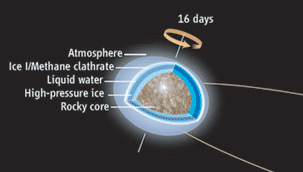 Could an ocean on Titan contain life? New observations from NASA's Cassini spacecraft lead planetary scientists to consider the possibility. Orbiting Saturn, Titan is larger than Mercury, Pluto, and all other moons in the solar system except Jupiter's Ganymede. Now it joins the handful of satellites perceived to have ice-covered oceans.
Christophe Sotin and Gabriel Tobie, "Titan's Hidden Ocean" [summary], doi:10.1126/science.1155964, p 1629-1630 v 319, Science, 21 Mar 2008.
Ralph D. Lorenz et al., "Titan's Rotation Reveals an Internal Ocean and Changing Zonal Winds" [abstract], doi:10.1126/science.1151639, p 1649-1651 v 319, Science, 21 Mar 2008.
A Deep Ocean--and Life?--for Titan, by Richard A. Kerr, ScienceNOW Daily News, 20 Mar 2008.
Cassini Spacecraft Finds Ocean May Exist Beneath Titan's Crust, NASA News Release 08-085, 20 Mar 2008.
Life on Europa or Other Moons? is a related CA webpage. Search for "Titan".
Thanks, Larry Klaes.
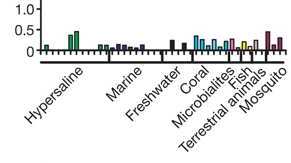
Genes for (bacterial) gliding motility are found in viruses in the listed ecosystems. |
14 March 2008
Viruses serve as gene banks for ecosystems?! In a study of microbial interactions within nine ecosystems, viruses were seen to carry large loads of DNA without using such DNA themselves. Forest Rohwer of San Diego State University, a member of the research team, believes that the viruses probably transfer such excess DNA to bacteria during infections, and thereby pass on "new genetic tricks" to their microbial hosts. The study also indicates that by transporting the DNA to new locations, viruses may serve as important agents in the evolution of microbes.
Elizabeth A. Dinsdale et al., " Functional metagenomic profiling of nine biomes" [abstract], doi:10.1038/nature06810, p 629-632 v 452, Nature, 3 Apr (online 12 Mar) 2008.
New Window Opens On The Secret Life Of Microbes, The National Science Foundation [also SciencDaily.com], 12 Mar 2008.
Surprising discovery from first large-scale analysis of biodiversity and biogeography of viruses, EurekAlert.org, 17 Mar 2008.
Viruses and Other Gene Transfer Mechanisms is a related CA webpage [ What'sNEW about HGT What'sNEW about HGT  ]. ].
The NASA Astrobiology Institute Virus Focus Group includes Forest Rowher: What'sNEW, 19 Oct 2003.
Thanks, Hans-Peter Wheeler.
14 March 2008
Meteorites with the highest observed concentrations of amino acids have been examined at the Carnegie Institution. They were collected in Antarctica in 1992 and 1995 and held at NASA's Johnson Space Center. Subsequently, extraterrestrial purine and pyrimidine compounds were confirmed in the Murchison meteorite. Could amino acids in meteorites come from life beyond Earth?
Z. Martins et al., "Indigenous amino acids in primitive CR meteorites" [abstract], arXiv:0803.0743v2, 10 Mar 2008.
Zita Martins et al., "Extraterrestrial nucleobases in the Murchison meteorite" [abstract], doi:10.1016/j.epsl.2008.03.026, p 130-136 v 270, Earth and Planetary Science Letters, 15 Jun (online 20 Mar) 2008.
Meteorites may seed life on Earth, by Vritika Prakash, The Johns Hopkins Newsletter, 3 Apr 2008.
Meteorites a rich source for primordial soup, PhysOrg.com, 13 Mar 2008.
More Evidence That Life Started in Space, FoxNews.com, 14 Mar 2008.
Life's Building Blocks From Space..., ScienceDaily.com, 13 Mar 2008.
A carbonaceous meteorite collected in Antarctica... is a related What'sNEW article with expanded discussion, 5 Mar 2008.
Comets... is a related CA webpage.
Thanks, Stan Franklin and Google Alerts.
14 March 2008
Instead of sweeping uncertainty under the rug, science communicators should help the public understand the logical and systematic procedures by which scientists confront it — Ruth Cronje, University of Wisconsin-Eau Claire
"Going Public with the Scientific Process" [html], doi:10.1126/science.319.5869.1483d, p 1483 v 319, Science, 14 Mar 2008.
13 March 2008
The biosphere of the Earth can ...be thought of as linked to a galactic or cosmic biosphere — Chandra Wickramasinghe
Chief Exponent of Panspermia Says Buddhism Provided the Philosophical Backdrop to Theory of Life in the Universe, interview by Walter Jayawardhana, American Buddhist Net News [and Sinhalaya News Agency], 11 Mar 2008.
Chandra Wickramasinghe's statement in Arkansas, Dec 1981.
Thanks, Google Alerts.
5 March 2008
A carbonaceous meteorite collected in Antarctica contains amino acids that are predominately left-handed. Three chemists at Arizona State University have found "enantiomeric excesses" (ee's) in amino acids and other organic molecules in GRA95229 (fragments pictured). Similar asymmetries have been seen in other meteorites, like Murchison, but ASU claims that this is the first analysis clearly proving that the ee's cannot have been caused by earthly contamination.
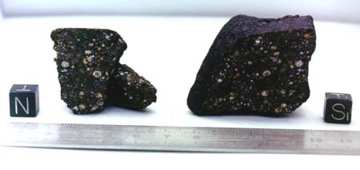
Until recently, life was the only process known to create excesses of left-handed amino acids or right-handed sugars. Finding them in meteorites was a big surprise. The least disturbing explanation is that the meteorites were contaminated after arrival on Earth.
But if the ee's in meteorites are not contaminants, another explanation is needed. ASU's team opines that they must be caused by nonbiological processes, like polarized light, in space. And this is good news, they write, because ee's arriving from space would make excellent ingredients for a prebiotic soup on Earth. For example, they could speed the origin of life by "acting as asymmetric catalysts in the aldol condensation of glycoladehyde."
Of course, the proposed nonbiological processes creating ee's are blatantly ad hoc. Without them, indigenous ee's in meteorites would have to come from life beyond Earth. They would be, not prebiotic, but "post-biotic."
The ASU researchers never even mention the chance that life beyond Earth could be the source for indigenous ee's in meteorites. A naive reader of their analysis might suppose that they are completely unaware of this glaring alternative. But that is impossible. ASU's avoidance of this subject is inexplicable.
Sandra Pizzarello et al., "Molecular asymmetry in extraterrestrial chemistry: Insights from a pristine meteorite" [link], doi:10.1073/pnas.0709909105, p 3700-3704 v 105, Proc. Natl. Acad. Sci. USA, 11 Mar (online 29 Feb) 2008.
 Key to life may have developed before its origin on Earth, by Jenny Green, ASU, 3 Mar; also Newswise.com, 29 Feb 2008.
Amino Acid Asymmetry in the Murchison Meteorite! is a related CA webpage, posted 14 Feb 1997.
Fossilized Life Forms in the Murchison Meteorite is a related CA webpage, posted 29 Feb 1997.
Evidence for Indigenous Microfossils in a Carbonaceous Meteorite is a related CA webpage, posted 2 Aug 2004.
Comets: The Delivery System is a related CA webpage.
27 February 2008
 The hypothesis that life in rock could have been transferred between planets... is plausible — Sherry L. Cady
Gerda Horneck et al., "Microbial Rock Inhabitants Survive Hypervelocity Impacts on Mars-Like Host Planets: First Phase of Lithopanspermia Experimentally Tested" [open access pdf], doi:10.1089/ast.2007.0134, v 8 n 1, Astrobiology, Spring 2008.
Life Forms Ejected on Asteroid Impact Could Survive to Reseed Earth, Mary Ann Liebert, Inc., 26 Feb 2008.
Bacteria: The Space Colonists is a related CA webpage.
Thanks, Larry Klaes.
24 February 2008
An intuitively unlikely evolutionary event has, in fact, occurred at least twice in primates — Cesar A. Virgen et al.
In cosmic ancestry, species acquire new genetic programs by importing them, whole or in parts. After new sequences are acquired, powerful software management systems may duplicate, relocate, assemble, optimise and test them for usefulness. This acquisition-and-deployment process would have outcomes ranging from lethal to beneficial. Darwinian natural selection would purge the worst and retain the best acquisitions for future generations. If this scenario is correct, there shoud be evidence for it in the fast-growing databases of genomic sequences. There is such evidence. Among prokaryotes, evolution by gene transfer is already the rule. Among multicelled eukaryotes, sequences still recognizable as having been introduced by viruses often outnumber regular genes, and apparent examples of beneficial genetic programs that emerged by the above scenario are accumulating too rapidly to keep count.
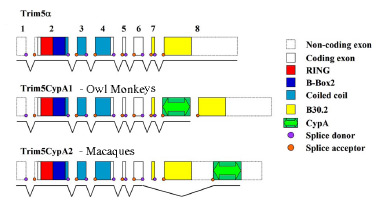
Adapted from Stoye and Yap |
If a given genetic program emerged this way among eukaryotes, couldn't it have emerged more than once? One would think so. Now, research by three different medical research teams upholds this expectation. Their evidence shows that a gene conferring HIV immunity in monkeys was created by the same process at least twice.The gene, TRIMCypA, was created when a sequence encoding cyclophilin A (CypA) was inserted in a specific location, deposing another sequence in a certain predecessor gene (TRIM5). It happened in South American owl monkeys and in Old World macaques. The two insertions were clearly separate events, because in owl monkeys CypA lies between the seventh and eighth exons, but in macaques it is downstream of the eighth exon. Also in macaques the deposed sequence (B30.2) includes an extra fragment (exon 7) not deposed in owl monkeys, and the resulting immunities pertain to different HIV types.
Cesar A. Virgen et al., from The Rockefeller University elaborate —
- Previously, the generation of a chimeric gene encoding a TRIM5-CypA fusion protein was thought to be an improbable event that occurred uniquely in owl monkeys.... However, essentially the same protein has been generated in pigtailed macaques via an independent retrotransposition event.
- That the same fusion protein has arisen twice, independently, during primate evolution seems intuitively astonishing.
- ...It is even conceivable that a single ancient retroviral pandemic led to the selection and convergent evolution of the TRIMCyp protein in both Old and New World monkeys.
Darwinists now acknowledge that eukaryotes may acquire useful new genetic programs by gene transfer, although most say the phenomenon is rare. Darwinists do not attempt to explain how or why acquired programs subsequently become properly assembled. More luck, probably. But HIV immunity by the same insertion in the same gene, twice in a row? Virologist Greg Towers thinks, It's like lightning has struck twice.
Sam J. Wilson et al., "Independent evolution of an antiviral TRIMCyp in rhesus macaques", doi:10.1073/pnas.0709003105, p 3557-3562 v 105, Proc. Natl. Acad. Sci. USA, 4 Mar 2008.
Cesar A. Virgen et al., "Independent genesis of chimeric TRIM5-cyclophilin proteins in two primate species", doi:10.1073/pnas.0709258105, p 3563-3568 v 105, Proc. Natl. Acad. Sci. USA, 4 Mar 2008.
Greg Brennan et al., "TRIMCyp expression in Old World primates Macaca nemestrina and Macaca fascicularis", doi:10.1073/pnas.0709511105, p 3569-3574 v 105, Proc. Natl. Acad. Sci. USA, 4 Mar 2008.
Jonathan P. Stoye and Melvyn W. Yap, "Chance favors a prepared genome" [extract], doi:10.1073/pnas.0800667105, p 3177-3178 v 105, Proc. Natl. Acad. Sci. USA, 4 Mar (online 25 Feb) 2008.
Imitating monkey's 'jumping genes' could lead to new treatments for HIV, EurekAlert.org, 18 Feb 2008.
Evolution of a TRIM5-CypA Splice Isoform in Old World Monkeys, by Newman RM, Hall L, Kirmaier A, Pozzi LA, Pery E, et al., doi:10.1371/journal.ppat.1000003, e1000003 v 4 n 2, PLoS Pathogens, 2008.
HIV's ancient legacy, NatureNews, 29 Feb 2008.
Viruses and Other Gene Transfer Mechanisms is a related CA webpage [ What'sNEW about HGT ].
Introns: A Mystery is a related CA webpage.
Thanks, Ruth Metcalfe, for the reprint.
22 February 2008
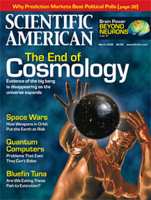 All scientific theories are subject to revision as more data are gathered and analysed. But a pair of cosmologists have now proposed that the big bang theory may be exempt from this process. They suggest that only now — and not later — cosmologists may have specially privileged access to the ultimate truth about the universe. They write —
 ...Must science in the future always reflect more empirical knowledge than existed in the past? Our recent work suggests that on cosmic timescales, the answer is no. We may be living in the only epoch in the history of the universe when scientists can achieve an accurate understanding of the true nature of the universe. We have long felt that big-bang cosmologists are too assertive. On thin and contradictory evidence, they claim to know precisely how and when the universe began. Now this assertiveness appears to have undergone its own rapid inflation.
Lawrence M. Krauss and Robert J. Scherrer, "The End of Cosmology?" [intro], p 46-53 v 298, Scientific American, Mar 2008.
The End and the Big Bang is a related CA webpage.
Exceeding Our Grasp: Kyle Stanford's book about constant revision in science, reviewed 23 Nov 2006.
16 February 2008
| The choanoflagellate genome, like the genomes of many seemingly simple organisms sequenced in recent years, shows a surprising degree of complexity.... Many genes involved in the central nervous system of higher organisms, for example, have been found in simple organisms that lack a centralized nervous system — Nicole King |
More metazoan genes came before metazoa. Following the sequencing of Monosiga brevicollis, two biologists at the University of California, Berkeley, discuss the unexpected cadherin genes found in it. Cadherin genes are essential for metazoan development, as cells differentiate and bind to form various organs and tissues. M. brevicollis is a unicellular choanoflagellate. Unicellular organisms do not undergo cell differentiation and the development of organs and tissues. "Given the absence of overt cell adhesion in M. brevicollis, one might expect choanoflagellates to have fewer cadherin genes than metazoans," to put it mildly. Yet this choanoflagellate has 23 cadherin genes, even more than are found in Drosophila melanogaster, the well-studied fruitfly.
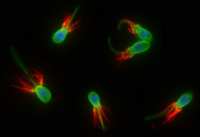 "Monosiga brevicollis leads a unicellular lifestyle and is not known to form cell-cell contacts. Therefore, the biological processes mediated by choanoflagellate cadherins remain enigmatic." For darwinism, certainly. For darwinism, this surprise calls for new speculation. Did other choanoflagellates use the cadherin binding function to form colonies? Did the crucial metazoan functions luckily accompany this primtive one?
In cosmic ancestry, genetic programs exist before they are expressed. The programming in cadherin genes had to be somewhere before the ancestors of higher animals acquired it. For cosmic ancestry, finding genes in organisms unready to use them is not a surprise, but an endorsement.
Nicole King et al., "The genome of the choanoflagellate Monosiga brevicollis and the origin of metazoans" [abstract | Editor's Summary], doi:10.1038/nature06617, p 783-788 v 451, Nature 14 Feb 2008.
Monika Abedin and Nicole King, "The Premetazoan Ancestry of Cadherins" [abstract], doi:10.1126/science.1151084, p 946-948 v 319, Science, 15 Feb 2008.
Genome of marine organism tells of animals' one-celled ancestors, by Robert Sanders, UC Berkeley NewsCenter, 14 Feb 2008.
Metazoan Genes Older Than Metazoa? is a related CA webpage with more examples.
More genes seem to precede the need for themselves, about related work by King et al., What'sNEW, 20 Jul 2003.
6 February 2008
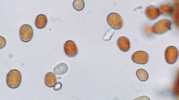 Red rain particles ~500x by Godfrey Louis Red rain particles ~500x by Godfrey Louis |
The Red Rain of Kerala has historical precedents, according to doctoral student Patrick McCafferty of Queen's University, Belfast. Examining 136 accounts of colored rain, lakes or rivers, he found that sixty of them, or 36% "were linked to meteoritic or cometary activity." A recent example from Kerala, a state in India, began on 25 July 2001, when a sonic boom, possibly caused by a meteorite, was followed within hours by red-colored rain. The red rain fell intermittently, with diminishing frequency, for two months. Its color comes from tiny cells that look biological but lack detectable DNA. The phenomenon remains under study.
P. McCafferty, "Bloody rain again! Red rain and meteors in history and myth" [abstract], doi:10.1017/S1473550407004016, International Journal of Astrobiology, online 16 Jan 2008.
Claim of alien cells in rain may fit historical accounts: study, World Science, 22 Jan 2008.
The red rain of Kerala — our first discussion of the phenomenon, with links, in What'sNEW, 23 Oct 2003.
Thanks, Chandra Wickramasinghe.
31 January 2008
 SPIE's 11th Astrobiology Conference will be held 12-14 August 2008 in San Diego. The Conference Chairs are Richard B. Hoover, Gilbert Victor Levin, Alexei Yu. Rozanov and Paul C.W. Davies. SPIE is "an international society advancing an interdisciplinary approach to the science and application of light." Hoover founded the astrobiology conference series and has chaired or co-chaired every meeting.
Instruments, Methods, and Missions for Astrobiology XI, San Diego Convention Center, 12-14 Aug 2008.
Fossilized Life Forms in the Murchison Meteorite discusses Richard Hoover's work released at SPIE's Astrobiology Conference of 1997.
Evidence for Indigenous Microfossils in a Carbonaceous Meteorite describes Richard Hoover's work released at SPIE's Astrobiology Conference of 2004.
15 January 2008
 The latest morphological studies with nearly exhaustive sampling of Cretaceous fossils... have all shown significant gaps in the 'younger' fossil record compared to the much 'older' molecular dating of the marsupial and placental lineages, a phenomenon with which molecular evolutionists also agree. The Curator of Vertebrate Paleontology of the Carnegie Museum of Natural History makes this observation in a major review article incorporating the latest data, in Nature. (The review is part of a series commemorating Carl Linnaeus, "the Father of Taxonomy.") Geneticists, using DNA sequence comparisons, routinely find genetic programs that are much older than paleontologists, using the fossil record, would predict. This chronology — genetic programs composed before natural selection on Earth could affect them — is a jarring anomaly for darwinism. But it would actually be logical and necessary if genetic programs come from cosmic ancestry.
Zhe-Xi Luo, "Transformation and diversification in early mammal evolution" [abstract], doi:10.1038/nature06277, p 1011-1019 v 450, Nature, 13 Dec 2007.
Metazoan Genes Older Than Metazoa? is a related CA webpage.
15 January 2008
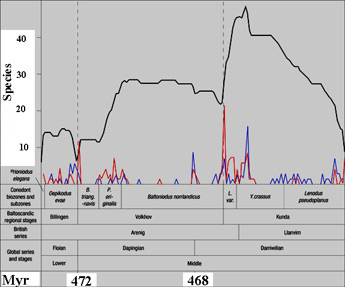
Graph shows the number of brachiopod species that were extant (black line), that originated (red spikes), and that went extinct (blue spikes) during a ten-million year period in the Lower and Middle Ordovician. The second surge is "perfectly contemporaneous" with the very first impacts following "the largest documented asteroid breakup event during the past few billion years." |
Did meteors cause the Great Ordovician Biodiversification Event? An international team of geologists and paleontologists has observed that the sudden 4-fold diversification of seafloor creatures about 470 million years ago coincided with an intense bombardment of meteorites. "The precise coincidence between these two events is established by bed-by-bed records of extraterrestrial chromite, osmium isotopes and invertebrate fossils in Middle Ordovician strata in Baltoscandia and China."A strictly darwinian account for a diversification event caused by a meteor bombardment is unknown. But with cosmic ancestry there are two plausible, non-exclusive scenarios. The meteor bombardment could have accompanied the delivery of new genetic programs from space, and/or the environmental changes it caused could have triggered the deployment of silent genetic programs already in Earth's biosphere.
Birger Schmitz et al., "Asteroid breakup linked to the Great Ordovician Biodiversification Event" [abstract], doi:10.1038/ngeo.2007.37, p 49-53 v 1, Nature Geoscience, 1 Jan 2008 (online 16 Dec 2007).
Florentin Paris, "...Meteoritic spur to life?" [abstract], doi:10.1038/ngeo.2007.63, p 18-19 v 1, Nature Geoscience, 1 Jan 2008.
Richard A. Kerr, "Did an Asteroid Shower Kick-Start the Great Diversification?" [summary], doi:10.1126/science.318.5858.1854, p 1854 v 318, Science, 21 Dec 2007.
Neo-Darwinism: The Current Paradigm is a related CA webpage with a section about punctuated equilibrium.
Metazoan Genes Older Than Metazoa? is a possibly related CA webpage.
19 Aug 2019: Paleologists have analyzed the Ordovician surge in biodiversity.
15 January 2008
Did life begin on a radioactive beach? An astrobiologist at the University of Washington in Seattle "has added to the existing long and varied list of hypotheses" for the origin of life. He has "demonstrated in laboratory experiments that [1-8 percent uraninite in sand] could produce the chemical energy to generate some of the molecules in water which produce amino acids and sugars – key building blocks of life...."
 The origin-of-life problem has a software aspect and a hardware aspect. Efforts on the software aspect have produced nothing. The newest proposal seems even to retreat from the hardware aspect to something antecedent: Can anyone propose an environment that could foster some of the the materials necessary for the origin-of-life? Yes, a Washington astrobiologist can. For that we admire his imagination and diligence. But we think he has not reduced even the hardware aspect of the origin-of-life problem. Rather, he recognizes more of its magnitude.
Zachary Adam, "Actinides and Life's Origins" [abstract], doi:10.1089/ast.2006.0066, p 852-872 v 7, Astrobiology, Dec 2007.
Lewis Dartnell, "Did life begin on a radioactive beach?" [first paragraphs], New Scientist, 12 January 2008.
Radioactive Hot Spots on Earth's Beaches May Have Sparked Life by Ian James O'Neill, Universe Today, 12 Jan 2008.
Life on Earth 'began on a radioactive beach' by Nic Fleming, Telegraph.co.uk, 9 Jan 2008.
The RNA World is the main CA webpage about origin-of-life theories.
Thanks, Larry Klaes.
14 January 2008
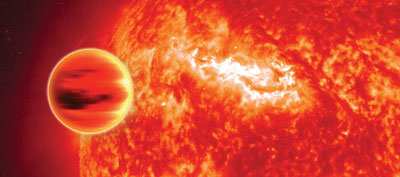 Extrasolar planets are the subject of a recent interview with Dimitar Sasselov, the Director of Harvard's Origins of Life Initiative. About 270 "exoplanets" have been confirmed so far, with more seen weekly. The ones detectable with today's methods are all larger than Earth, and many of these have surprisingly low densities. Still, planets from two to ten times the size of Earth may be earthlike "rocky" or "ocean" planets. The handful of these already confirmed are probably too hot or too cold, but ones with suitable temperatures could possibly harbor life. New instruments like the French-led COROT, launched in December 2006, and NASA's Kepler, scheduled for launch in early 2009, will help us find them and see if they do.
Dimitar D. Sasselov, "Astronomy: Extrasolar planets" [text | Editor's Summary], doi:10.1038/451029a, p 29-31 v 451, Nature, 3 Jan 2008.
Origins of Life Initiative at Harvard University.
Harvard's Origins of Life program held its inaugural symposium, What'sNEW, 9 Nov 2006.
Life on Europa or Other Moons? has links about possibly habitable moons and planets in our own solar system.
14 January 2008
...Only rarely have phylogenetic studies of morphology and DNA data agreed in plant studies, even in well-studied groups. Two English botanists make this observation in a review article about the origin of flowering plants. Currently there are several conflicting theories and no consensus on the subject. We note that conflicting phylogenies are not surprising, when darwinists underestimate the role of gene transfer in evolution.
 Michael W. Frohlich and Mark W. Chase, "After a dozen years of progress the origin of angiosperms is still a great mystery" [abstract], doi:10.1038/nature06393, p 1184-1189 v 450, Nature, 27 Dec 2007.
The Tree of Life is a related CA webpage.
4 January 2008
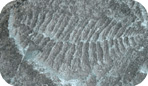 A sudden diversification of life..., if confirmed,... reinforces the idea that major evolutionary innovations occurred in bursts. A team of of paleontologists from Virginia Polytechnic Institute and State University in Blacksburg found that the oldest assemblage of Ediacaran plant fossils, from 575-565 million years old, contains every form of plant life subsequently seen throughout the entire Ediacaran. The diversification must have happened suddenly. Named the Avalon explosion, its pattern is similar to that seen for the Cambrian Explosion of animal life at least 30 million years later; and its timing coincides exactly with a sudden infusion of oxygen into the oceans.
Rapid explosions of diversity among plants or animals are not consistent with Darwin's original theory whereunder all evolution is slow and gradual. Amendments to accomodate evidence for "punctuated equilibrium" have been necessary. But rapid evolutionary changes are consistent with cosmic ancestry, where apparently novel genetic programs are actually already available. And if an environmental change immediately triggered the Avalon explosion, preexisting genetic programs for the new forms would seem to be required.
Bing Shen, Lin Dong, Shuhai Xiao and Michal Kowalewski, "The Avalon Explosion: Evolution of Ediacara Morphospace" [abstract], doi:10.1126/science.1150279, p 81-84 v 319, Science, 4 Jan 2008.
Another Big Bang for Biology by Phil Berardelli, ScienceNOW Daily News, 3 Jan 2008.
Neo-Darwinism: The Current Paradigm is a related CA webpage with a section about punctuated equilibrium.
|