COSMIC ANCESTRY | Quick Guide | What'sNEW - Later - Earlier - Index | by Brig Klyce | All Rights Reserved | |||||||||
What'sNEW Archives, November-December 2006
Many genes once thought to be unique to humans have been in the tree of life for over a half billion years — Scientific American  Human, Sea Slug Brains Share Genes for Alzheimer's and Parkinson's, by Charles Q. Choi, Scientific American.com, 29 Dec 2006. Human, Sea Slug Brains Share Genes for Alzheimer's and Parkinson's, by Charles Q. Choi, Scientific American.com, 29 Dec 2006. Viruses and Other Gene Transfer Mechanisms is the main related CA webpage [ Viruses and Other Gene Transfer Mechanisms is the main related CA webpage [ What'sNEW about HGT What'sNEW about HGT  ]. Human Genome Search... is a related CA webpage. Metazoan Genes Older Than Metazoa? is a related CA webpage. ]. Human Genome Search... is a related CA webpage. Metazoan Genes Older Than Metazoa? is a related CA webpage. Thanks, Jerry Chancellor. Thanks, Jerry Chancellor.
We humans are embedded in a microbial world that we barely acknowledge — microbiologist Norman Pace of the University of Colorado at Boulder.  Eoin L. Brodie et al., "Urban aerosols harbor diverse and dynamic bacterial populations" [abstract], 10.1073/pnas.0608255104, p 299-304 v 104, Proc. Natl. Acad. Sci. USA, 2 Jan 2007. Microbiology's Air Force, by John Bohannon, ScienceNOW Daily News, 20 Dec 2006. Study Finds the Air Rich with Bacteria, by Dan Krotz, Berkeley Lab, 18 Dec 2006. Bacteria... is a related CA webpage. Eoin L. Brodie et al., "Urban aerosols harbor diverse and dynamic bacterial populations" [abstract], 10.1073/pnas.0608255104, p 299-304 v 104, Proc. Natl. Acad. Sci. USA, 2 Jan 2007. Microbiology's Air Force, by John Bohannon, ScienceNOW Daily News, 20 Dec 2006. Study Finds the Air Rich with Bacteria, by Dan Krotz, Berkeley Lab, 18 Dec 2006. Bacteria... is a related CA webpage.
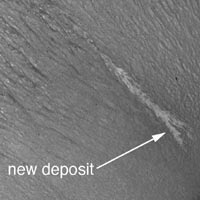
Water still flows on Mars?! Gullies photographed by NASA's Mars Global Surveyor in 2004 and 2005 contain bright deposits that were absent when the same gullies were photographed in 1999 and 2001. The observations suggest that liquid water flowed on the surface of Mars during the past decade, NASA says. Investigator Michael Malin comments, This possibility raises questions about how the water would stay melted below ground, how widespread it might be, and whether there's a below-ground wet habitat conducive to life.
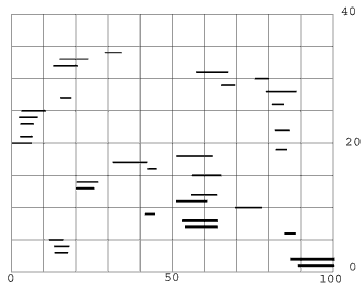
Britten thinks most of the segmental duplications were created by unequal crossover, but he admits, "It is not easy, based on open criterion sequence similarity data, to decide what the mechanisms of duplication have been." Other mechanisms that may account for some duplications include the insertion of DNA copies of mRNA leading to processed genes, chromosome duplication, polyploidy, segmental duplication, and transduction by transposable elements. Britten also reports:
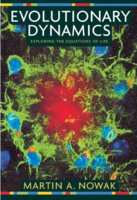 Evolutionary Dynamics, by Martin Nowak, "introduces readers to the powerful yet simple laws that govern the evolution of living systems, no matter how complicated they might seem." So reads the dust jacket of a new book by the director of Harvard University's Program for Evolutionary Dynamics. Inferring that we would learn about the evolution of complicated living systems – possibly even a process producing new genetic programs – we bought the book. Its chapters cover "fitness landscapes, mutation matrices, genomic sequence space, random drift, quasispecies, replicators, the Prisoner's Delimma, games in finite and infinite populations, evolutionary graph theory, games on grids, evolutionary kaleidoscopes, fractals, and spatial chaos." The book is heavy, handsome, nicely illustrated, plenty of equations, thirty-five dollars.
But not a mention of any process that even might produce new genetic programs. Our mistake. In the promotional sentence quoted first above, "they" refers to complicated laws. And a perfectly good book about them. Nowak is especially interested in the evolution of language, which he analyzes with attention to "all possible grammars." We do not doubt that his insights have merit. We wish he would also use his mathematical talent to wonder if darwinian processes can write new genetic programs, or if, as we suspect, another acccount of them is needed. In review Sean Nee writes, Many entities replicate. ...Our genes replicate when we reproduce. Replication may occur with errors as mutation. Natural selection occurs when entities with different properties replicate at different rates, and random chance may also intervene to dilute the action of selection. These are the basic elements of the evolutionary process: if you doubt that such simplicity can produce anything interesting, look around you. (That's why we do doubt it!) Actually, Nee does not say that Nowak will answer our question. Instead, Nee remarks, Is the work relevant to anything? Who knows? Who cares? It's a riot.
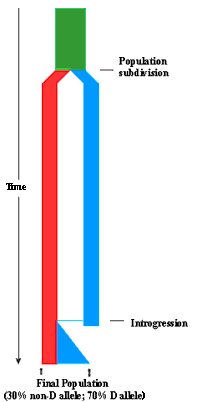
"...Two subdivided populations were reproductively isolated from each other for a prolonged period.... A rare interbreeding event occurred between the two populations ~ 37,000 years ago, which resulted in the introgression of a copy of the D allele from the D-bearing into the non-D population. The D-bearing population subsequently went extinct, but the introgressed D allele spread to exceptionally high frequency in the remaining population because of positive selection." The researchers observe that, if correct, this example buttresses the important notion that... our species has benefited evolutionarily by gaining new advantageous alleles. This manner of gaining them, interbreeding with a (virtually) separate species, is new to us. However it happens, we are glad that mainstream researchers are recognizing the evolutionary importance of acquiring whole genes.
We are grateful to Stanford for introducing us to the "tacking" problem: "Evidence E confirming theory T will equally well confirm theory T + C (where C is any further claim that does not undermine T's implication of E), thus offering spurious confirmation to C itself" (p 14-15). In our opinion, the claim that darwinian evolution can compose wholly new genetic programs has been tacked onto the better-supported parts of the theory of evolution, and likewise, has no legitimate confirmation. Now we know a name for this error. We are also grateful for the opening of the second chapter, an hilarious quote from Mark Twain (p 27). Stanford concludes that the proper attitude toward science is "epistemic instrumentalism," which "rejects the idea that even the most fundamental claims of theoretical science will persist indefinitely into the future..." (p 211). We were even more interested in another approach he calls "confirmational holism" whereunder "all beliefs are confirmed only by serving as part of a collection that accounts well for our perceptual experience as a whole" (p 38). Stanford comments, "If the extreme holist turns out to be right after all, this simply means that the reach of the problem of unconceived alternatives is considerably longer than it appears at first glance..." (p 40, his italics). We found the book enlightening and informative, although we were disturbed by the sugestion that Isaac Newton was "profoundly mistaken" (p 9). If Newton was wrong, what hope is there? And even if some of Stanford's sentences required more than one reading (p 21), we recommend him to anyone interested in the philosophy of science. We wish the philosophy of science would take an interest in us! P. Kyle Stanford, Exceeding Our Grasp: Science, History, and the Problem of Unconceived Alternatives, Oxford University Press, USA, ISBN 0195174089, 248 pages, 20 Apr 2006.
P. Kyle Stanford, "Darwin's Pangenesis and the Problem of Unconceived Alternatives" doi:10.1093/bjps/axi158, The British Journal for the Philosophy of Science, online 1 Feb 2006.
Tim Lewens, "Science Undermined by Our Limited Imagination?," Science, 25 Aug 2006.
Evolution versus Creationism is a related CA webpage.
Creationism versus Darwinism: A Third Alternative is a related CA webpage.
Testing Darwinism versus Cosmic Ancestry is a related CA webpage.
Research Statement, P. Kyle Stanford, Nov 2020.
...I have recently argued that specific features of the institutional context and incentive structure of modern professionalized science may render us even more vulnerable to this problem of unconceived alternatives than were scientific communities of the past....
The genes are the immortals — Richard Dawkins Richard Dawkins, The Selfish Gene, Oxford University Press, 1976. p 36.
Metazoan Genes Older Than Metazoa? is a related CA webpage.
Thanks, Mary Midgley, Evolution as a Religion, Methuen & Co., Ltd., 1985. Revised edition: Routledge, 2002.
 Book Reviews Book Reviews
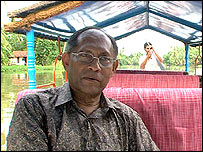
Chandra Wickramasinghe is featured on BBC's Horizon series. He discusses the space-survival capabilities of bacteria, the Red Rain of Kerala, and NASA's planned programs to search for life elsewhere in the solar system. The show airs on BBC Two at 21:00 GMT today. Searching for 'our alien origins', by Andrew Thompson, BBC Horizon, 14 Nov 2006. Chandra Wickramasinghe has a background essay and updates.
Thanks, Chandra, Tim Taylor and Yahoo! Alerts.
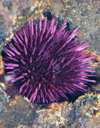 The eyeless, earless [sea urchin] has genes that, in us, are involved in detecting sight and sound — Nature.
If new genetic programs must be deilvered by gene transfer, as we believe, we would expect to also find them sometimes in life forms that do not need them. Many such examples are known. The apparently unnecessary sensory genes in the sea urchin look like another example. Sea urchin genes reveal surprising similarities with humans, News@Nature.com, 9 Nov 2006. Decoded sea urchin genome shows surprising relationship to man, EurekAlert!, 9 Nov 2006. Special Section: "The Sea Urchin Genome," p 938-962 v 314, Science, 10 Nov 2006. Viruses and Other Gene Transfer Mechanisms is a related CA webpage [ What'sNEW about HGT ]. Metazoan Genes Older Than Metazoa? is a related CA webpage.
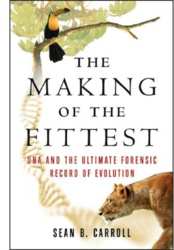 The Making of the Fittest, by geneticist Sean B. Carroll, promises to explain "how species acquire entirely new abilities" (p 36). To do this Carroll will make use of "a body of new facts," the DNA sequences that are now 40,000 times more voluminous than only 25 years ago (p 15). Having read the book with close attention, we thought it was well-written, informative and enjoyable. But unpersuasive.
In our opinion, examples supporting the strictly Darwinian account of new genetic programs are "too rare and too weak" to sustain the case. At the turn of the millenium, the best such example was the apparent derivation of the gene for antifreeze glycoprotein from a gene for a pancreatic enzyme in Antarctic cod, first published in 1997. We were surprised to read that in 2006, with thousands of times more data available, this example may still be the best one — it is the featured example of Carroll's opening chapter. "Adaptation to cold ...also required some invention. Foremost among these is the invention of 'antifreeze' proteins" (p 25, Carroll's italics). Chapter Four, titled "Making the New from the Old", is where Carroll has promised to explain the really good stuff, how Darwinian evolution can compose the genetic programs for "entirely new features". But the chapter is only about how the duplication and optimization of opsin genes can expand the range of color vision. We agree that this capability is impressive, but it remains in the microevolution category. In our view, none of Carroll's detailed examples is about sustained or sustainable macroevolutionary invention. Instead, typical examples are things like color polymorphism in Northwestern garter snakes, and the diversity of fruit fly wing patterns. In Chapter Eight, "The Making and Evolution of Complexity", Carroll takes this challenge head-on. "It is not uncommon for individuals to acknowledge variation and evolution within species ('microevolution') but to refuse to extrapolate those processes to ...the evolution of complex features above the species level ('macrevolution')" (p 192). From there he uses the morphological evolution of eyes to reconstruct the past, a method we consider almost irrelevant for genetics. He concludes, "...The [genetic] tool kit itself is ancient and must have been in place in a common ancestor before most types of modern animals bodies and body parts evolved" (p 203). We have two problems with this conclusion. First, if a crucial genetic program existed long before its full deployment, how does darwinism account for that? It just was? We think this order of events supports cosmic ancestry and not darwinism.
For all of our disagreements with the tone and substance of Carroll's newest book, we still enjoyed reading it. We even recommend it as an exemplar of darwinism's finest. But keep your eyes open.
First on the schedule was Jack Szostak, Professor of Genetics at Harvard Medical School, who explained that he uses a "bottom up" approach to the origin of life. He said that cells need (1) a boundary containing (2) a genetic material, and he showed how certain lipids might form bound shapes and even develop tails. Szostak also mentioned several molecules such as GNA, GmNA, and TNA that might represent steps to DNA, through or around the RNA World. Next, Chemistry Professor George Whitesides considered a broad range of problems confronting origin-of-life theorists, including how to realistically achieve a sufficient concentration of the precursor chemicals. More than once he lamented, "There are simply too many possible reactions." The featured public lecture was given by Robert M. Hazen of the Carnegie Institution of Washington's Geophysical Laboratory and a Professor of Earth Science at George Mason University. Speaking about the role of minerals in the origin of life, he showed slides illustrating how, under the right circumstances, PAHs (polycyclic aromatic hydrocarbons) might stack like a deck of cards, acquire side chains on their outer edges, pair up with similar stacks, and morph into helical molecules resembling DNA. Hazen is invited to give more detailed presentations today to students and faculty. In addition to the Harvard Astronomy, Molecular Biology and Chemistry departments mentioned above, faculty from the departments of Earth and Planetary Science (Stein Jacobsen), Organismic and Evolutionary Biology (Andrew Knoll), Environmental Chemistry (Scot Martin), and another astronomer, Martin Lecar, will also participate, according to the symposium's printed handout. When we asked about representation from Computer Sciences, or from anyone who could face the software aspect of the origin-of-life problem, Dr. Sasselov acknowledged the need and said that a way to meet it was being sought. The program is new and growing. We will watch with keen interest.
| |||||||||
COSMIC ANCESTRY | Quick Guide | What'sNEW - Later - Earlier - Index | by Brig Klyce | All Rights Reserved |
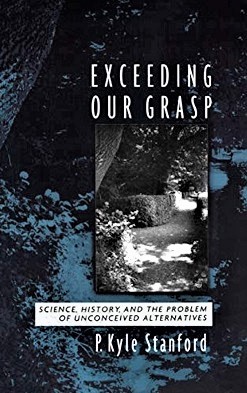 Exceeding Our Grasp, a first book by philosopher Kyle Stanford, reminds us that science habitually considers only limited choices and overlooks numerous possibilities. If science has blind spots, how reliable is it as a description of the real world? With this question in mind, Stanford first explains different approaches to, and longstanding issues for, the relationship between science and reality. He then devotes three chapters to the biological problems of inheritance and generation that troubled Charles Darwin, Francis Galton and August Weissman. After their best ideas didn't work, they failed even to conceive of alternatives that could have removed the difficulties. This failure is typical for all of science, he believes. We are reminded of the current false dichotomy between strict darwinism, and creationism/Intelligent Design. (This dichotomy is especially troubling because both sides work hard to keep the alernatives limited to those two.)
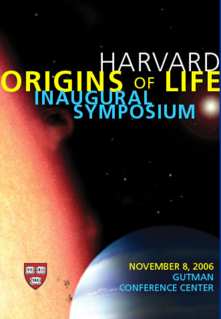 Harvard's Origins of Life program held its inaugural symposium, 2-5 PM yesterday, 8 November, in Harvard's Gutman Conference Center in Cambridge MA. Approximately 200 people attended, by our estimate. The program's Director, astronomer Dimitar Sasselov, served as moderator and later spoke about his own technically challenging search for Earthlike extrasolar planets.